
Design-Build vs. Hiring an Architect, Builder and Landscaper Separately
Should you hire a builder or an architect first? Here is how design-build compares with hiring an architect, a builder and a landscaper separately, and when each approach makes sense.
Most projects start with a search for one trade: a home builder, a commercial contractor, a landscaper or someone to draw the plans. It is natural to think of a project in pieces. But how those pieces are hired shapes the cost, the schedule and how much of the coordination lands on you, the owner.
This guide compares the two ways to run a project, explains when each makes sense, and answers the question owners ask most: should I hire a builder or an architect first?
Should I hire a builder or an architect first?
With the traditional approach, you hire the architect or designer first, then take the finished drawings to builders for bids. The risk is that the design is completed before anyone who will build it has priced it, so it can come back over budget and need to be redrawn.
Hiring a builder first gives you early pricing, but the builder still needs someone to design the project, and you end up coordinating the two.
The third option is to hire both at once. A design-build firm puts the designers and the builders on the same team from the first meeting, so the design is shaped by real costs from the start and there is no hand-off between companies.
The traditional way: separate hires
On a typical home or commercial project, the traditional route looks like this:
- Architect or designer: draws the plans and handles approvals.
- Builder or general contractor: bids on the drawings and builds the project.
- Landscaper: designs and installs the grounds, usually after construction.
- Property manager or maintenance company: looks after the property once it is finished.
Each company has its own contract, its own schedule and its own view of the project. When the drawings and the job site disagree, or the landscape plan does not fit what was built, the owner often ends up in the middle, passing questions between companies that each answer for only their part.
The design-build way: one firm, one contract
With design-build, one firm designs, permits, builds and finishes the project. At LMI Designs, the same firm also designs and installs the landscape and maintains the property afterwards.
- One point of contact. Questions go to one team that is responsible for the whole result.
- Cost is checked while the design is still flexible. The crews who will build it review the drawings before they are final.
- The house and the grounds are planned together. Terraces, pools, plantings and drainage are part of the first design, not an add-on.
- Faster openings for commercial spaces. Design, permits and construction overlap instead of waiting on hand-offs, which matters when rent has already started.
- Care after completion. The team that built it knows where every system runs and how every detail was made.
Side by side
- Contracts: separate hires means three or four; design-build means one.
- Who coordinates: with separate hires, often the owner; with design-build, the firm.
- When cost is known: with separate hires, after the design is finished and bid; with design-build, while the design is still being shaped.
- Landscape: with separate hires, usually planned after the building; with design-build, planned together with it.
- If something goes wrong: with separate hires, each company answers for its own part; with design-build, one firm is responsible.
When separate hires can make sense
If you already have a finished design from an architect you love, or the job is a single small task, such as replacing a patio or painting a room, hiring one trade directly can be the simplest route. Design-build pays off most on projects where design, construction and landscape all affect one another: a new home, a full renovation, a waterfront property or a commercial build-out on a deadline.
A recent example in Westport
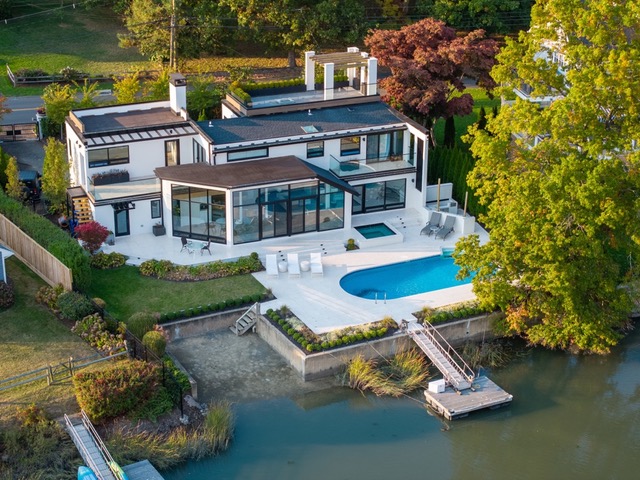
At the Westport Waterfront Residence, a dated house on the water became a modern home with roof terraces, a glass sunroom, a pool terrace and a private dock. The house, the terraces and the grounds down to the water were planned as one project, which is the kind of work where a single firm makes the biggest difference.
Questions owners ask
Is a design-build firm a builder or a designer?
Both. A design-build firm is the designer and the builder. At LMI Designs it is also the landscape and property care team, all under one contract.
Is design-build more expensive?
Not necessarily. Because builders review the design early, costly changes on site are less common, and there is no separate bidding stage. The total depends on the project, not the approach.
Who handles permits and approvals?
The design-build firm does. Permits and approvals are part of the same contract.
Can I still choose finishes and make design decisions?
Yes. You work directly with the designers, and because the builders are on the same team, you see what each choice costs before it is final.
Where does LMI Designs work?
LMI Designs is based at 15 Bridge Square in Westport, Connecticut, with work across Fairfield County, New York City and Long Island, Charleston, South Carolina, and Palm Beach and Boca Raton, Florida.
Whether you started out searching for a luxury home builder, a commercial contractor or a landscape designer, LMI Designs can take the whole project from the first drawing to the finished space. Call (203) 505-7047 to start a conversation.
Planning a project?
Talk to the team that designs, builds and maintains it.